IT Course Training Digital Marketing Training 100% Job placement Internship UG & PG Software Project Free Workshop for College IT Course Training Digital Marketing Training 100% Job placement Internship UG & PG Software Project Free Workshop for College
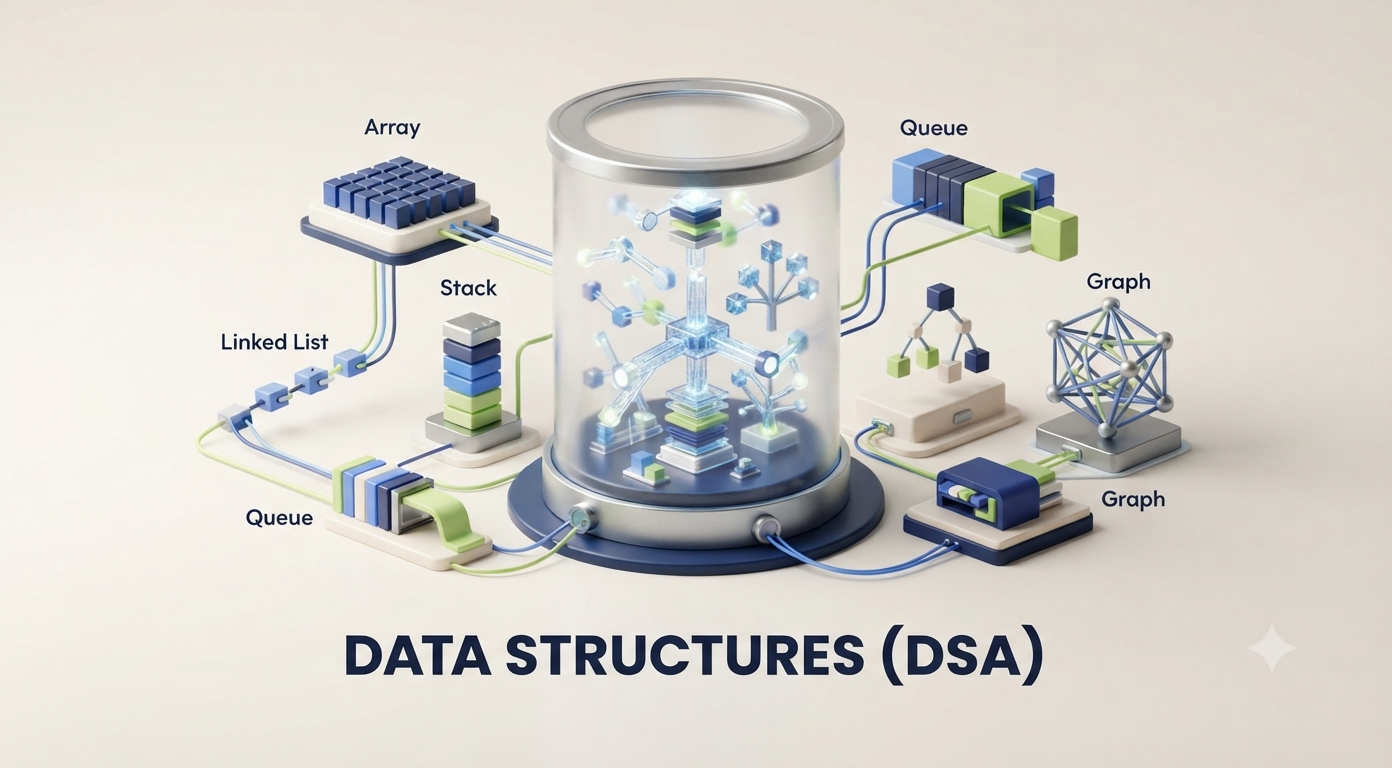
This Data Structures and Algorithms (DSA) course is designed to help students, beginners, and software developers build a strong foundation in computer science and logical thinking. The program covers essential data structures like arrays, linked lists, trees, and graphs, alongside crucial algorithms for sorting, searching, and recursion. Students will gain extensive hands-on experience solving complex coding problems, preparing them for technical interviews and competitive programming.
Core Data Structures
Master the internal workings of arrays, linked lists, stacks, queues, trees, and graphs to organize data efficiently.
Essential Algorithms
Learn to implement and analyze searching, sorting, and recursive algorithms to optimize performance and execution time.
Problem Solving
Develop strong logical thinking and critical reasoning skills by tackling real-world coding challenges and interview questions.
Why Learn Data Structures?
Data Structures and Algorithms are the fundamental building blocks of all software development. A strong grasp of DSA is essential for writing efficient, optimized, and scalable code. Top tech companies prioritize candidates with excellent problem-solving abilities and algorithmic knowledge. Learning DSA helps you think critically, write better software, and confidently ace technical interviews across various programming languages like Java, Python, C, and C++.
Master Arrays, Strings, Linked Lists, Stacks, and Queues.
Non-Linear Structures
Understand Trees, Graphs, Heaps, and Hash Tables.
Algorithms
Implement Sorting, Searching, Recursion, and Dynamic Programming.
Problem Solving
Practice patterns for coding interviews and complex logic building.
Linear Structures
Master Arrays, Strings, Linked Lists, Stacks, and Queues.
Non-Linear Structures
Understand Trees, Graphs, Heaps, and Hash Tables.
Algorithms
Implement Sorting, Searching, Recursion, and Dynamic Programming.
Problem Solving
Practice patterns for coding interviews and complex logic building.
Course Highlights
Arrays & Strings
Master manipulation and traversal techniques for contiguous data elements and characters.
Linked Lists
Learn to implement and traverse singly, doubly, and circular linked lists dynamically.
Stacks & Queues
Understand LIFO and FIFO operations and their applications in software systems.
Trees & Graphs
Explore hierarchical structures, binary search trees, and complex graph algorithms.
Searching & Sorting
Analyze and implement efficient algorithms like binary search, merge sort, and quick sort.
Recursion
Grasp the concept of functions calling themselves to solve complex repetitive problems.
Problem Solving
Build strong logical reasoning by tackling real-world coding problems efficiently.
Coding Interview Preparation
Practice frequently asked technical questions to excel in product-based company interviews.
Tools & Platforms Covered
Java
A robust, object-oriented language widely used for enterprise-level algorithmic problem solving.
Python
A versatile language with highly readable syntax, perfect for quickly implementing logic.
C++
A high-performance language essential for competitive programming and fast execution.
Visual Studio Code
A powerful, lightweight source code editor with built-in debugging support.
Git
The industry-standard version control system for tracking source code changes efficiently.
GitHub
A cloud-based platform for code hosting, collaboration, and showcasing your project portfolio.
LeetCode
A leading platform for practicing coding problems frequently asked in technical interviews.
HackerRank
An online competitive programming platform tailored for skill evaluation and practice.
Frequently Asked Questions
The Data Structures course in Salem teaches students how to organize, store, and manage data efficiently using different data structures and algorithms. It helps develop strong problem-solving and programming skills.
Data Structures training in Salem covers arrays, strings, linked lists, stacks, queues, trees, graphs, hash tables, sorting, searching, recursion, and basic algorithms.
Students, fresh graduates, programming beginners, and software development learners can join a Data Structures course in Salem. It is especially useful for students preparing for programming assessments and technical interviews.
Yes. Data Structures courses in Salem can begin with programming fundamentals and gradually introduce different data structures, algorithms, and problem-solving techniques through coding exercises.
Data Structures can be implemented using programming languages such as C, C++, Java, and Python. The choice of programming language depends on the course curriculum and learning objectives.
Learning Data Structures can help students strengthen their programming, logical thinking, problem-solving, and coding skills. These skills are useful for software development roles and technical interviews.
Students looking for Data Structures training institutes in Salem can compare institutes based on the syllabus, coding practice, problem-solving exercises, trainer experience, practical projects, course duration, and placement assistance.
Enquire For Course
Fill out the form below for course fees, batch schedules, and scholarship details.